|
Shivat HaMinim - Description of Elements in the Piece

 |
The Tree
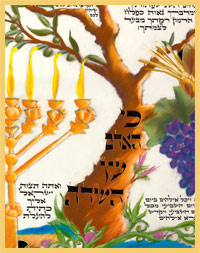
The base of the tree represents the beginning of the Briah (Creation) of the World, of the Land of Israel and of Man and the Jewish People.
The tree is compared to the Jewish People. Crafted as a papercut in the middle of the trunk are the Hebrew words from the pasuk: "Ki Ha'Adam Eitz HaSadeh" (a man is compared to the tree of the field). Just as a tree gives fruit to the hungry, shade to the weary, wood in order to build and air in order to breathe, so too we learn that man must do the same; he must perform Chassadim (acts of loving-kindness) for his fellow.
If a person is indeed compared to a tree, then the branches are likened to the mental and physical faculties of the individual. Judaism teaches that a person must use those abilities for the betterment of society: to create, to build, to repair and to heal in this world. G-d wants us to sanctify the physical.
Thus the fruit signify the Mitzvot (Commandments) done by each Jew, which are the highest level of sanctifying the physical. The tree begins to spread itself out, specifing a particular mitzvah with each branch.
|
 |
The Rivers
There was one river which sprouted from the base of the Tree of Life and Knowledge in the Garden of Eden, which then split off into four rivers. Praat (Euphrates) went to Eretz Yisrael – shown on the left side of the tree- and the Pishon, Gichon and the Chidekel went to Chutz L'Aretz (the Diaspora) – shown on the right side.
There are three main ideas which the rivers represent in the artwork.
One, that by flowing out into all corners of the world, this is a reminder of G-d's presence in all parts of the world.
Two, that just as water is perhaps the most basic necessity which physically nourishes the world, so to the Torah is the source of our spiritual nourishment. Just as one must have water to survive physically, so too a Jew needs Torah to survive spiritually.
And three, that just as the rivers flow to all parts of the world, so to, man must go out into all parts of the world to use his G-d given talents and skills to uplift, refine and sanctify the physical world.
|
 |
Wheat
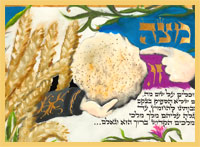
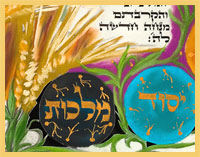
In discussing the seven species, wheat takes the precedence as a more "important" food. It is the classic example of man taking a G-d given physical element (wheat kernel) and developing it further for its ultimate spiritual use. Here, matzah is depicted. It is made from wheat and is used in the mitzvah of eating matza on Passover.
|
 |
Barley
Barley is related to the mitzvah of Counting of the Omer, which takes place during the 49 days between Passover and Shavuot. This counting connects the exodus from Egypt with the giving of the Torah on Mount Sinai. The Kabbalists explain that the 49 days correspond to the forty-nine drives and traits of the human heart. Shavuot, the "Festival of Weeks" is the product of this count, achieved by a methodical, 49-step process of self-refinement within the human soul.
|
 |
Grapes
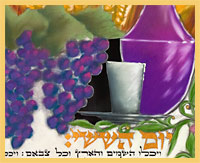
The Shabbat is declared holy through a prayer known as Kiddush, however, Jewish law prescribed that something physical must be used in conjunction with this prayer. Wine, produced from grapes, serves the purpose of making the holy day truly holy. The weekday is transformed into the holy Shabbat by avenue of the grapes.
|
 |
Olives
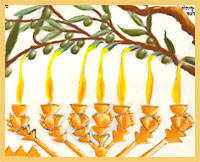
Pure olive oil was used for the daily lighting of the Menorah in the Holy Temple. The Menorah appears in the piece, with its flames alight, connecting right up to the olives and leaves themselves, the source of the oil.
|
 |
Dates
Dates originate in the date palm tree. Depicted near the dates are the Four Species connected to the Festival of Succot. Held together and waved at different times during the holiday, the four species are comprised of the citron fruit, the myrtle branch, the closed palm branch and the willow branch. The palm branch comes from the date palm tree.
|
 |
Figs
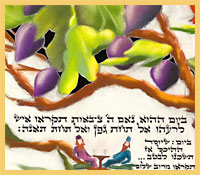
A verse written in the Prophet Zechariah, states that on a particular day, each person will call to his friend and sit under the grape vine and under the fig tree. This is understood to refer to the day on which the foundations of the Holy Temple in Jerusalem will be set. On that day, each man will sit with his fellow under the fig tree in peace and security, full of faith. Painted under the fig tree is a scene of two men, drinking a l'chaim in close camaraderie.
|
 |
Pomegranate
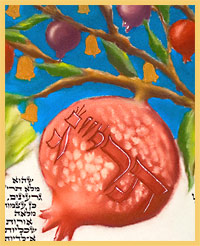
It is said that the six hundred and thirteen seeds of a Rimon (Pomegranate) are likened to the six hundred and thirteen Mitzvot of the Torah. The Malbim explains this comparison from a verse from Shir HaShirim (The Song of Songs). The texts are included around the Rimon, along with the abbreviation in Hebrew "TaRYaG", which is the numerical equivalent to six hundred and thirteen.
In addition, the Me'il, a sleeveless robe or tunic-like outer garment, was one of the eight articles of clothing that the Cohen HaGadol wore during his service in the Mishkan and the Beit HaMikdash. One of the elements unique to the Me'il was that the bottom hem was composed of a line of alternating golden bells and pomegranates of different colors. Whenever the High Priest would enter the Beit HaMikdash, his coming would be announced by the ringing of the bells. Here these different colored rimonim and bells are painted on a background of "Techelet", the sky blue color of the material that the Me'il was woven from.
|
| |
Bottom-Center Verse
A Land that Hashem your G-d seeks out; the eyes of Hashem, your G-d, are always upon it, from the beginning of the year to year's end. God is omniscient and oversees the entire world, but His principal attention is focused on Eretz Yisrael and from there His blessings flow to the rest of the world.
|
| |
Bottom-Right Verse
Moshe encouraged the nation to trust in God to insure their successful conquest of the Land and in describing this land, the Chumash describes: A Land of wheat, barley, grape, fig, and pomegranate; a Land of oil-olives and date-honey. |
|